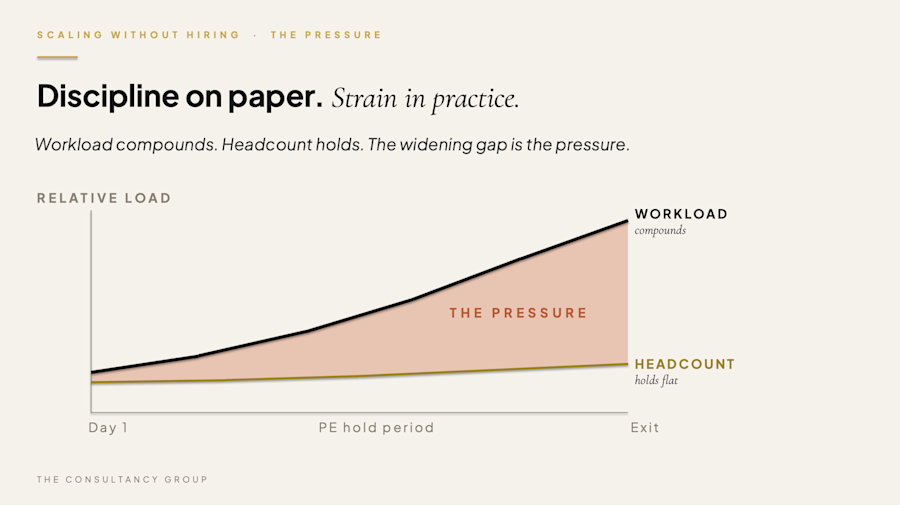
Across the briefs we're taking from PE-backed businesses, one tension keeps surfacing. CFOs are being asked to square an increasingly difficult circle: deliver accelerated growth, expand margins, and upgrade reporting sophistication, without materially increasing headcount.
On paper, it sounds like discipline. In practice, it's creating structural strain inside finance functions.
The Efficiency Expectation
According to Bain, around 70% of PE-backed companies are simultaneously pursuing growth and margin expansion. At the same time, McKinsey data shows that top-quartile finance functions operate at roughly 40% lower cost as a percentage of revenue than their peers. The implication is clear: efficiency is no longer a lever, it's an expectation.
But there's a disconnect.
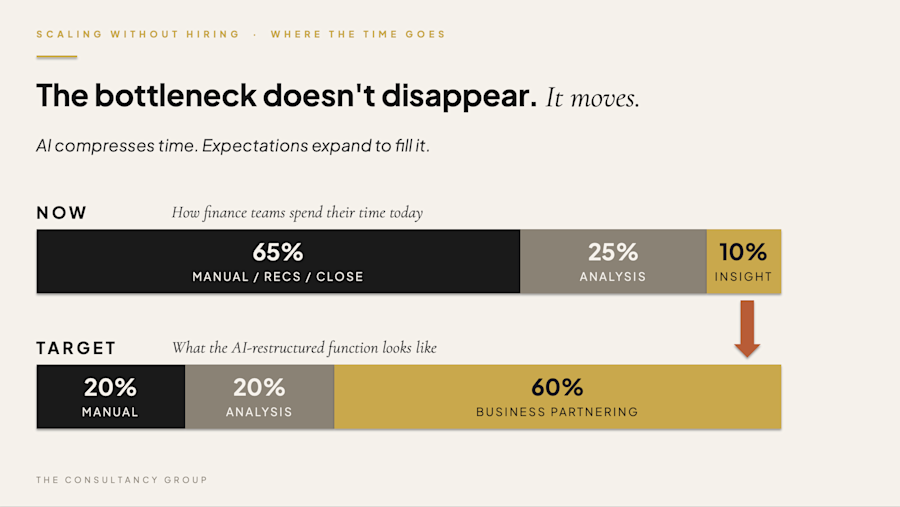
By most estimates, finance teams still spend the majority of their time, somewhere between 60 and 70%, on low-value, manual, or repetitive work: month-end close, reconciliations, standardised reporting. When growth accelerates, that workload doesn't scale linearly. It compounds. New entities, new reporting lines, more complex forecasting assumptions. The work multiplies faster than the team can absorb it.
This is where the narrative around AI enters, and where it often gets misunderstood.
The Bottleneck Moves
At a recent CFO roundtable I sat in on, one finance leader described how implementing AI-driven variance analysis had reduced manual commentary preparation by over 50%. Another shared how scenario modelling that previously took days could now be completed in hours.
But the more interesting insight wasn't the efficiency gain. It was what happened next.
In both cases, the time saved wasn't banked. It was reallocated. More scenarios. More board scrutiny. Faster turnaround expectations.
The bottleneck didn't disappear. It moved.
This is the core truth many PE-backed businesses are still grappling with:
AI doesn't remove work. It compresses time and raises expectations.
Redesigning the System
The most effective CFOs I'm speaking with are responding by redesigning how work gets done, not by layering AI onto existing processes.
That means being explicit about where AI replaces effort versus where it only accelerates it:
True replacement: reconciliations, variance commentary, data consolidation
Partial augmentation: forecasting, scenario modelling, planning cycles
Minimal impact: stakeholder alignment, judgement-heavy decisions, board communication
It also means rethinking team structure. Not just fewer people, but different roles. Fewer pure analysts, more commercially oriented operators who can interpret and act on AI-generated insight.
The PE Reality
The uncomfortable reality is that "scaling without hiring" is only possible if you redesign the system. If you don't, you simply create a higher-pressure version of the same constraints.
And in a PE environment, pressure compounds quickly.
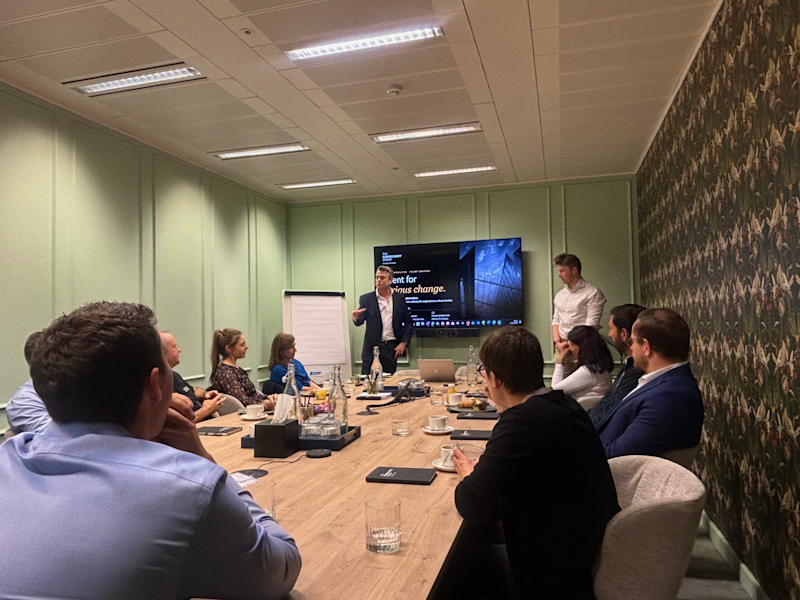
On Wednesday 17 June, we're hosting an invite-only breakfast session, AI in Finance: How to Scale Finance Teams for PE-Backed CFOs, with Peter Beard. We'll walk through practical capacity planning frameworks for the exact challenge above. Request your seat.